
Think of an animal.
A familiar favorite is a fine place to start. Search for its name and make your first guess.
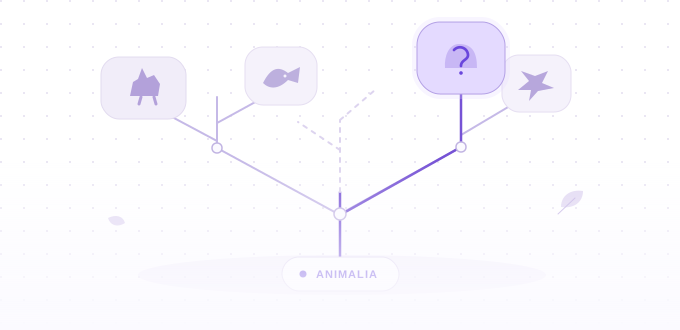
Follow the shared branches.
The closer the family, the closer you are.
Swipe sideways to explore the tree. Select a branch to learn more.
| Guess | Shared family | Clue |
|---|
Your guesses will appear here as the trail unfolds.
No guesses recorded for this round.
You don’t need to be a zoologist.
Just bring your curiosity.
A familiar favorite is a fine place to start. Search for its name and make your first guess.
We show the family group your guess shares with the mystery animal. Each branch is a clue.
Use what you’ve learned to get closer. You have 20 guesses to make your discovery.
THE CONNECTION COLLECTION
Featured reads that make the family tree click.
No animals found. Try a different name.
THE CONNECTION COLLECTION
Whales and hippos. Hyenas and cats. Discover unexpected relatives through short reads, clear explanations, and sources you can follow.
UNEXPECTED RELATIVES
The mallard beats the wall lizard in this three-way comparison.
Of a mallard and a common wall lizard, the mallard is the closer relative of the Nile crocodile.
Of a mallard and a common wall lizard, the mallard is the closer relative of the Nile crocodile on this tree. If everyday categories make the lizard feel like the obvious answer, that is exactly what the comparison tests. A familiar appearance or a familiar label can suggest a starting guess, but neither replaces the relationships recorded in the tree.
The crocodile and mallard share Archosauria, the archosaur group. The crocodile and wall lizard meet at Sauria, a wider group containing all three paths in this example. Archosauria is nested within Sauria. Here Sauria is the scientific name of that broader group, not simply another way to say “lizards.” Reading the Latin label without checking its members would hide the useful distinction.
The crocodile does not become a bird because it shares the more specific group with the mallard. Their paths divide again below Archosauria. Nor does the wall lizard become unrelated: all three remain inside Sauria in this comparison. “Closer” is a comparison between branches, not a claim that one living animal descended from the other or that the less close candidate has no connection at all.
For this fixed trio, mark Archosauria beside the crocodile–mallard pair and Sauria beside the crocodile–wall-lizard pair. Then ask which shared group lies inside the other. That one step selects the mallard without relying on feathers, scales, or a vague resemblance score. If you only knew that all three belong to Sauria, you would still need the more specific connection to justify the choice.
Relationships follow NCBI Taxonomy. Branch order does not measure genetic similarity or time since divergence.
A LITTLE NATURAL CURIOSITY
AnimalLoop brings together animal games and discoveries. In the daily guessing game, find one mystery animal in 20 opportunities, following clues on the branches that connect animals to one another.
Open the daily game. Search for a common name, Chinese name, or scientific name, select an animal, and submit your guess. Every accepted guess uses one of your 20 opportunities. A wrong guess reveals a shared ancestral branch; use that clue to choose your next animal.
After your first guess, an available branch hint costs three opportunities. It reveals the next ancestral branch, without naming the answer or revealing a species or a narrower group. When only three opportunities remain, taking a hint uses them all and ends the round. You can also choose to reveal the answer and finish the round.
The tree follows NCBI Taxonomy, including groups without a formal rank. Branches show classification, not a similarity percentage or a measured time since divergence. Wikipedia may use a different classification.
You must guess the exact catalogued animal. Guessing one of its descendants does not count as a correct answer. When the closest shared branch would name the mystery animal, the game shows a higher ancestor to keep the answer hidden.
The daily puzzle resets at 00:00 UTC. Completed daily games count once toward your statistics; daily wins determine your streak. Practice rounds let you explore more animals without changing your daily streak or daily statistics.
No login is needed. Progress, preferences, and statistics are saved with localStorage in this browser. They do not sync between devices or browsers, and clearing site data removes them. See the privacy and source notes.
Browse the field guide for animal names, classification, reading, and source links. Wikipedia excerpts identify their source revision and CC BY-SA licence. Image credits link to the creator, original source, and individual licence; check those terms before reusing an image.
NOTES ON THIS EDITION
AnimalLoop saves your game progress in your browser. These notes describe the current game’s storage and the sources behind its animal family tree and field guide.
The game uses localStorage to save daily and practice progress, preferences such as language and theme, and daily statistics. There is no account or cloud sync. Clearing this site’s browser data removes those saved records; another device or browser has its own records. This edition has no analytics or advertising SDK.
Some images load from Wikimedia Commons. Its servers receive normal request information, including your IP address and browser request headers. Following a source link opens an external website, which follows its own privacy policy. See the Wikimedia privacy policy for its practices.
Classification follows NCBI Taxonomy. The game uses the catalogued lineage, including unranked groups, to connect guesses. It does not measure visual resemblance or genetic similarity, and other sources may use different classifications.
Wikipedia excerpts retain a link to their source revision and credit Wikipedia contributors under Creative Commons Attribution-ShareAlike 4.0. Images have individual licences and creator credits in their field notes; not every image uses the same licence. The local image credits also list bundled media sources.
Read the game instructions, explore the field guide, or start a daily game or practice round.